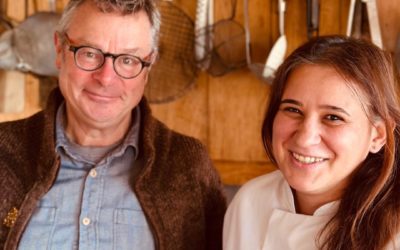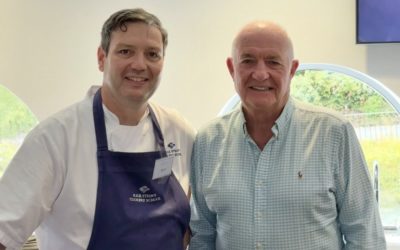
During his latest foodie fact-finding tour of the Isles of Scilly, researching the ingredients, makers and stories behind the Greatest British gourmet experiences, our founder and British Food Ambassador, James ‘GB’ Day met Arthur “Art” Miller, joint founder of Scilly Spirit, based on St Mary’s island at the heart of the Isles of Scilly. What emerged was a story of provenance, perseverance and island creativity — a drinks brand shaped as much by family roots and Atlantic realities as by flavour itself.
A distillery born of island life
Some drinks brands are built around a trend. Others are built around a place. Scilly Spirit belongs firmly in the second camp.
Set on St Mary’s the main island in the Isles of Scilly, the distillery was founded by Arthur “Art” Miller and his wife Hilary, the creative and hard-working multi-award-winning team behind one of the islands’ most distinctive premium drinks brands. Yet the business did not begin with a grand masterplan. It began, ‘Art’ told James, with something far more personal and practical.
“We came to the Isles of Scilly to be with my wife Hilary’s ‘Hils’ family that had been here for many generations, and so we obviously needed to do something to make a living here. Put simply, ‘Hils’ said ‘let’s make gin’ so we put our collective skills and experience in hospitality, marketing and of course drinks, and we created ‘Scilly Spirit’ ” commented Art.
That decision eventually led them to an unlikely home for the distillery: a former children’s soft play centre. It was not glamorous, but it was available, and on a small island space and access matters.
“We managed to find this building, bizarrely used to be a children’s soft play centre,” Art said. “The whole process started a couple of years before that too. It takes a lot of time to find a building and get licences and do all the things you need to do on the islands — a lot of research, lots of reading and learning and applications to get the relevant licences. So a lot was involved before we could actually get set up.”
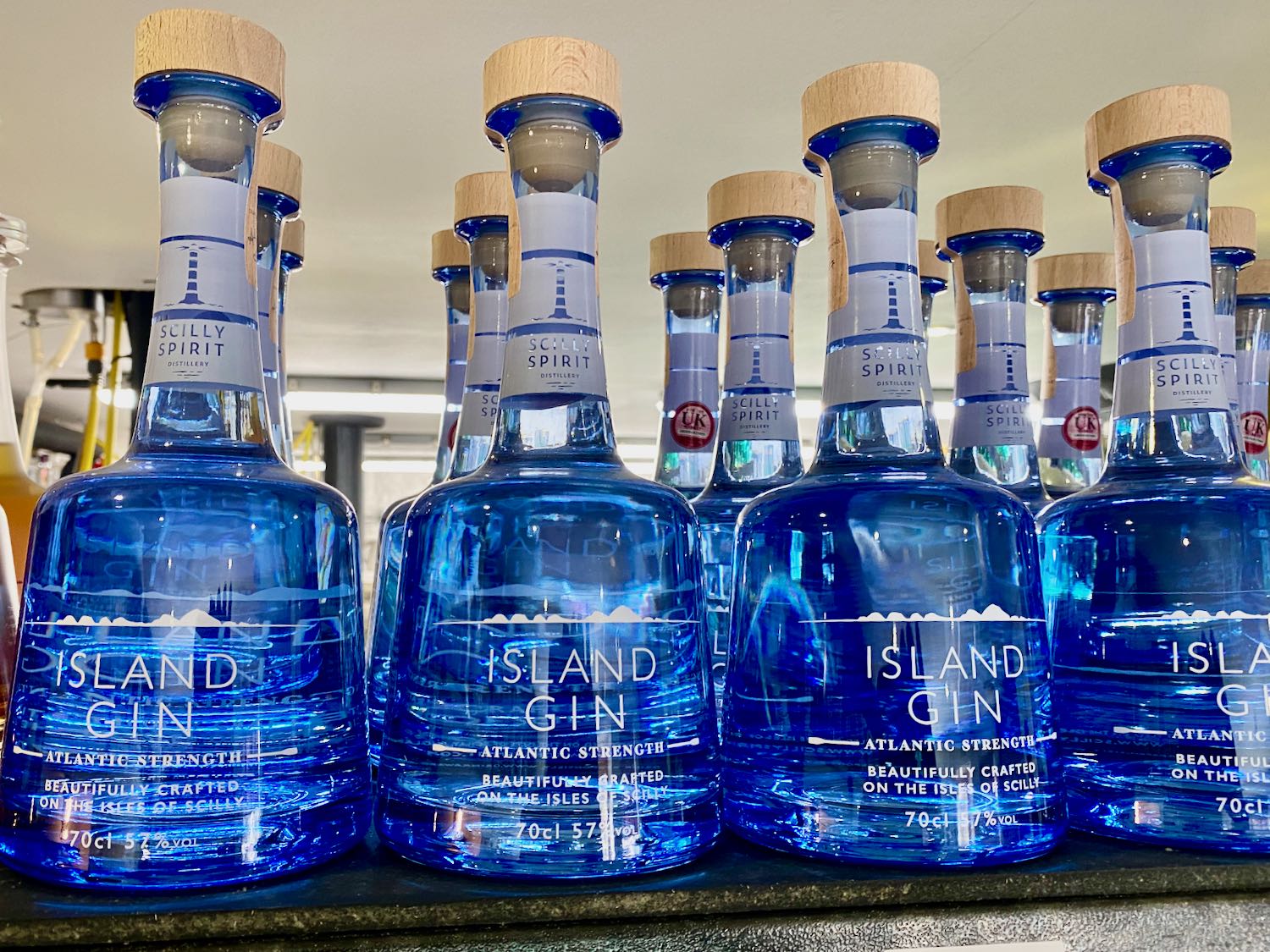
Scilly Spirit finally launched in May 2019, after around 18 months of preparation before opening its doors.
Distilling with 30 miles of The Atlantic in the way
What makes Scilly Spirit especially compelling is that island life is not simply the backdrop to the brand. It shapes almost every aspect of how the business operates.
“One of the biggest challenges is by the nature of being on an island,” Art explained. “We’ve got 30 miles of The Atlantic Ocean between us and Penzance, the edge of Cornwall.”
That distance brings a very particular kind of pressure. “We have the challenge of having to rely on the freight ship services to bring goods to us,” he said. “And then you’ve got the double whammy that you have to get everything back to customers on the UK mainland and beyond.”
It is a striking reminder that, while mainland distillers can work with relative ease, island makers must build a business around timetables, weather and added cost, and of course customer loyalty.
“That’s probably one of the biggest challenges of being an island-based distillery versus our UK mainland colleagues,” said Art. “They can just put anything on a truck, and that’s their easy mode of transport.”
Scilly Spirit is a drinks brand shaped by Atlantic logistics, not mainland convenience. For GourmetXperiences readers, that alone makes it stand apart.
Flavour inspired by shipwrecks, spice and family memory
Yet logistics are only part of the story. The real identity of Scilly Spirit lies in how Art and Hilary have translated island life and personal memory into flavour.
James’s time with Art revealed that the original gin was inspired by a mix of local maritime history, family recollection and the couple’s own taste preferences. The bottle design itself reflects Bishop Rock Lighthouse, while one of the key flavour inspirations came from the wreck of The Royal Oak, an East India spice trade ship lost near Bishop Rock in 1665.
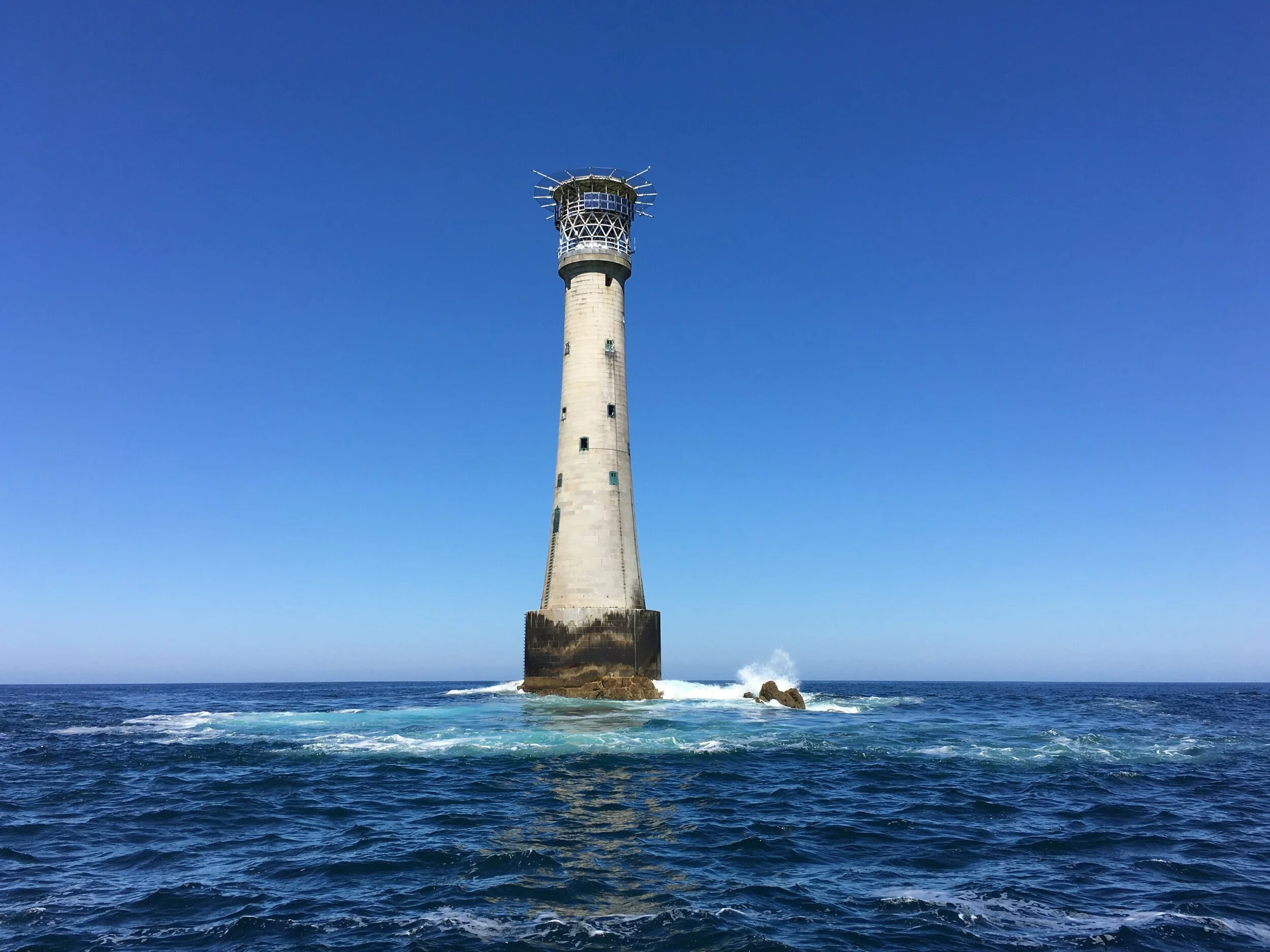
“Part of our research included looking at lots of shipwrecks that had taken place over the years,” Art said. “One of those was an East India spice trade ship called The Royal Oak.”
Because the captain survived and later filed a formal report explaining the loss, a record of the cargo remains…
“Fortunately for us, in his report he’d also included a list of the cargo that was on board,” said Art. “Part of that cargo was peppercorns from Java, Indonesia. So we thought, right, this is a genuine incident, took place right on the edge of Scilly and the edge of the UK. So peppercorns are one of the botanicals in our gin.”
Another key note came from a far more intimate source: “One of the botanicals that’s also quite prominent through the gin is orange peel,” Art explained. “The inspiration for that comes from my wife’s grandmother. She’d been making marmalade here for many, many years, and she was still doing this here when she was 100 years old.”
He added: “We’ve got lots of lovely fond memories of when it was a marmalade-making day — this lovely aroma of the oranges in Grandma’s kitchen. So we decided we wanted to capture that too.”
Layered into this are broader influences from the couple’s love of Asian cuisine, including the use of kaffir lime leaf. “We really make the gin from lots of things we like, including the types of foods and flavours we enjoy” Art said, “as well as those inspirational things about the peppercorns and the orange peel.”
The flavour story is built from memory, maritime history and personality, rather than from trend. That gives Scilly Spirit a depth that feels real and refreshingly unforced.
Sustainability shaped by island necessity
On a small island, sustainability is not a fashionable add-on. It is simply part of responsible working life.
That reality is especially true of water, a precious resource on Scilly, where much of the supply comes through desalination. Art explained that this shaped a key decision in how the distillery was designed to operate.
“We all have to be really cognitive and careful about how we use our water,” he said.
In distillation, the cooling process usually relies on a constant flow of cold water. Many mainland operations may allow that water to run away once heated. On Scilly, that approach did not sit comfortably.
“We didn’t like the idea of just putting cold water in and letting the hot water that comes out of that system run down the drain,” Art said. “We couldn’t afford to do that here on this island with such a scarce commodity.”
Instead, the distillery invested in a closed-loop refrigeration unit, allowing the same water to be reused continuously.
“What we’re in fact doing, because it’s a closed-circuit system, is we are just basically reusing the same 250 litres of water for cooling all the time,” he explained. “So all of our distilling here now for seven years — through all that time, we’ve only used the same 250 litres of water to fulfil that cooling process!”
It is the kind of detail that says a great deal about the ethos behind the brand.
On Scilly, sustainability is not branding — it is practical, necessary and part of the craft.
Rising costs and the realities of small-scale production
Like many independent producers, Scilly Spirit must also navigate rising energy, packaging and transport costs. On the islands, those pressures can feel even sharper.
Art pointed to electricity, glass and freight as constant challenges, alongside the knock-on effect of spirits duty.
“I think all of us producers are concerned about electricity price rises,” he said.
But again, the island factor adds another layer.
“The big cost for us is the cost of getting the goods here,” Art said. “We rely on the freight service, and obviously we’re quite an exposed location, so weather conditions are always things that, unfortunately, can affect that freight supply, as well as rising transportation costs, sometimes both ways.”
He was equally direct about the impact of duty, when asked what the government can do to help smaller distilleries like Scilly Spirit: “A single word is duty,” he said. “That’s the big one that really needs attention.”
Glass costs are forever increasing, now with an added glass tax!
These are not abstract pressures. They shape margins, prices and daily decisions. Yet what stands out is that Art and Hilary have continued to build with clarity and character, rather than allowing those headwinds to dilute the brand.
This is why many of their loyal customers are far beyond the shores of the islands and summer visitors, but also on the mainland and across the world via their website.
A natural next chapter: Island Whisky
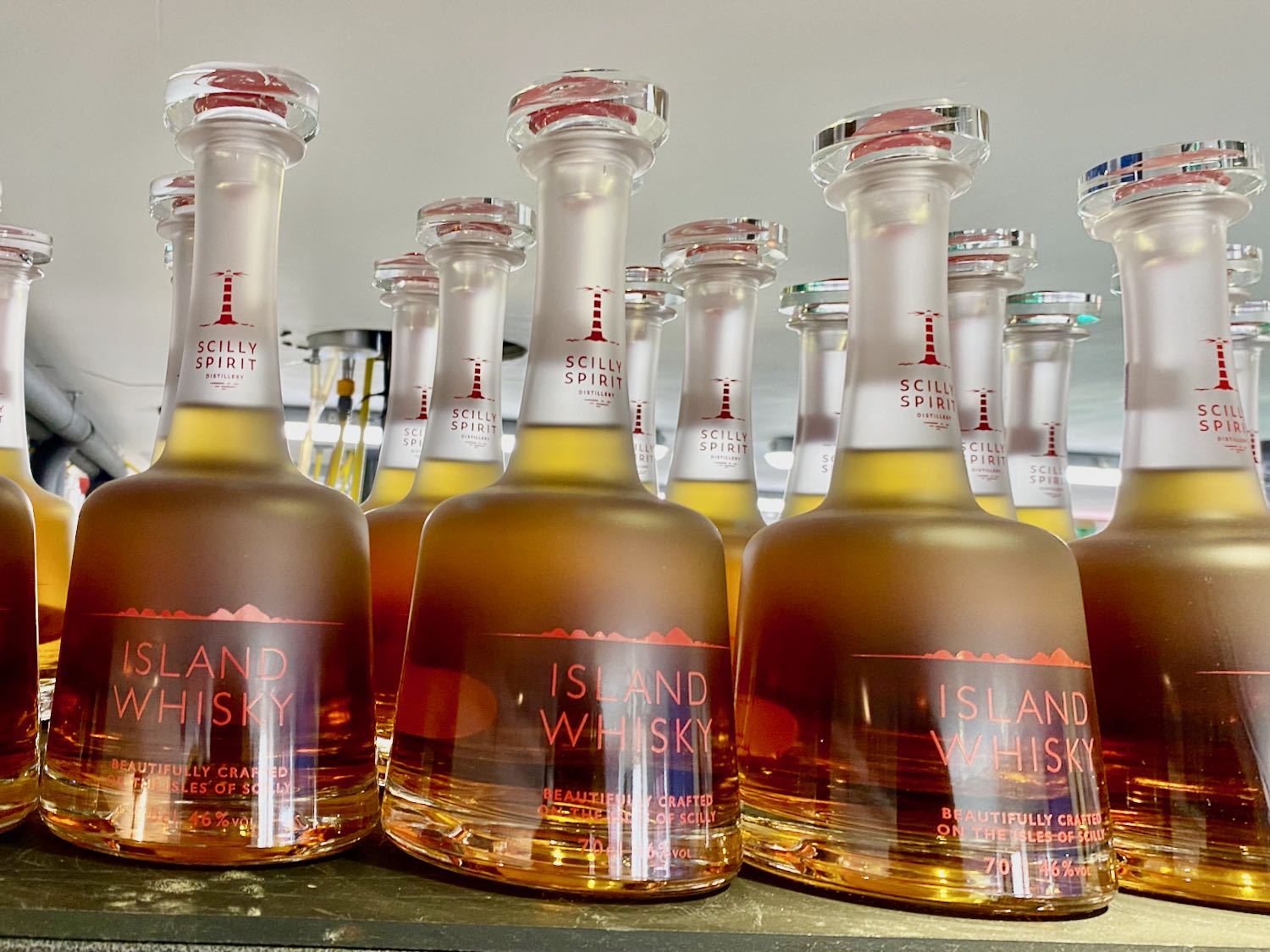
For all the strength of the gin story, whisky feels like a natural progression for Scilly Spirit.
As Art noted when speaking with James, what makes a whisky is patience: the spirit must spend a minimum of three years and one day in cask before it can take the name. At Scilly Spirit, that sense of time and craft is central to the approach. Their Island Whisky has emerged through a series of carefully considered releases, including Cask Release Three and Cask Release Four, with single malt, single cask credentials and cask choices such as European medium toasted oak helping to define the style. It is a measured, small-batch approach that suits the distillery perfectly, allowing each release to carry its own distinct island character
Produced entirely on St Mary’s, the distillery’s Island Whisky carries forward the same core values: provenance, patience, island identity and a strong sense of narrative. The whisky was first created in November 2021, following extensive research into flavour profile and cask selection, and has since emerged as a distinctive part of the Scilly Spirit story. The current release is a single malt, single cask, small-batch English island whisky, with a limited number of bottles helping to reinforce its collectable, place-led appeal.
The whisky also deepens the distillery’s maritime connection. The still used to distil it is named Sir Cloudesley Shovell, linking it to one of the islands’ most famous naval tragedies, while the visual identity draws on island fog, lighthouse imagery and the red of the Red Ensign associated with Scillonian III and local tripper boats.
In that sense, the whisky is not a departure from the brand’s earlier story. It is its continuation.
Island Whisky feels like the natural next chapter in a distinctly island-made story.
A genuine taste of Scilly
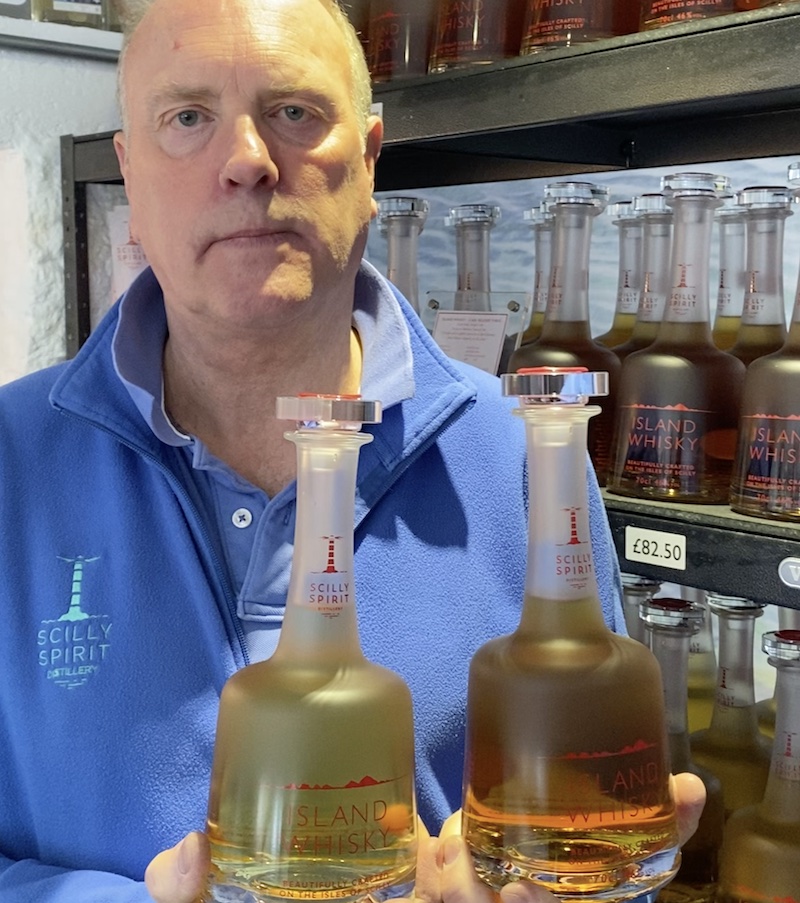
For GourmetXperiences, this is exactly the kind of maker-led experience worth celebrating.
Scilly Spirit is not simply a distillery to visit, nor just another bottle to admire. It is a story of family roots, island realities, creativity and resilience to create a truly British culinary experience. In Art and Hilary Miller, the Isles of Scilly have producers who understand that the most memorable drinks begin long before the first pour. They begin with place, people, adversity, imagination and craft.
At the very edge of Britain, Scilly Spirit has created something that feels increasingly rare: a drinks brand with true provenance, a clear point of view and a story worth travelling for.
Visit their website and order a bottle, or two, here
Scilly Spirit Gin School: Create your own island gin
One of the most engaging parts of the conversation with Art at Scilly Spirit was hearing how the distillery has turned its craft into a hands-on visitor experience. The Gin School is not simply a tasting or demonstration, but a chance for guests to step into the role of distiller themselves. As Art explained, small groups are welcomed into the distillery space, where participants work with their own compact stills and create a gin from start to finish using a wide choice of botanicals. The experience is designed to be intimate and social, with around six to eight people typically accommodated at a time, giving it the kind of personal feel that suits Scilly Spirit’s island setting.
What makes it especially memorable is the creative freedom involved. Art described a wall of over 60 botanicals from which guests can build their own recipe, shaping a gin that reflects their own tastes rather than following a fixed formula, with guests guided through flavour profiles before taking charge of their own mini still. That balance of expert guidance and individual choice is a large part of the appeal: guests are not just watching the process, they are actively making something that is uniquely theirs.
As Art told James, one of the pleasures of the session is how quickly strangers begin to compare notes, taste one another’s creations and share the fun of the process. That social element feels important. “This is not a solitary workshop, but an experience that brings people together through flavour, curiosity and a sense of occasion. There is also something satisfyingly complete about it: guests name their gin, see it labelled, and leave with a finished bottle that is unmistakably their own.”
Perhaps the most distinctive touch is what happens afterwards. Art explained that guests keep a copy of their recipe, while the distillery retains a digital version too. That means the experience does not have to end when visitors leave Scilly. Scilly Spirit can remake a guest’s gin to the same recipe and send it on, allowing them to reorder their own bespoke creation later. It is a clever extension of the experience — part souvenir, part story, part personal house gin — and exactly the kind of thoughtful detail that turns a holiday activity into something more lasting.
The experience lasts around three hours, which Art says gives people time to enjoy the full process, from choosing botanicals and distilling their spirit to bottling, labelling and packaging it themselves. Guests leave with 50cl of their own gin to take home.
For GourmetXperiences readers, that is where the Gin School really earns its place. It is not only a distillery attraction, but a genuinely immersive island food-and-drink experience: creative, convivial and rooted in the character of Scilly itself.
Scilly Spirit currently offers Gin School for One at £98 and Gin School for Two at £148, with sessions listed on Tuesdays from 11.30am to 2.30pm during the main season. Guests must be 18 or over.